
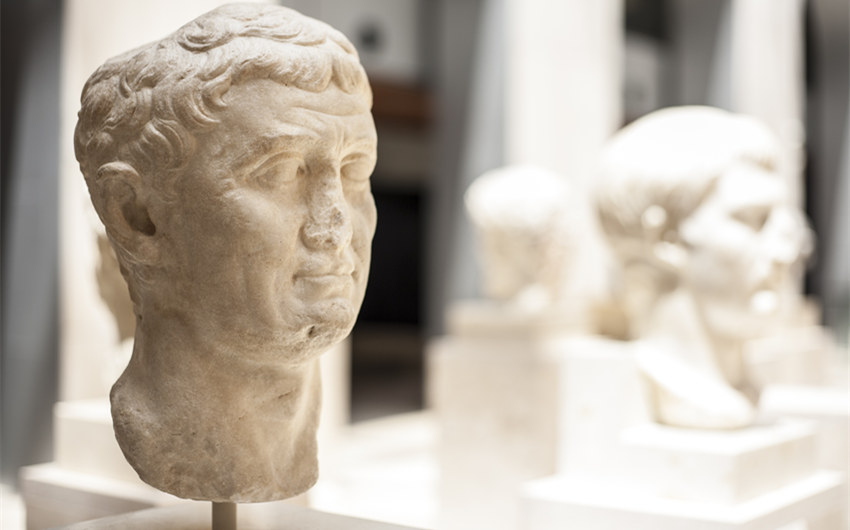
Mark Antony is one of those historical figures you think you know—until you look closer and realize his life was less “romance and scandal” and more hard-edged politics, brutal war, and a collapsing republic. He wasn’t simply Cleopatra’s lover or Caesar’s loyal friend. He was a skilled commander, a shrewd operator, and a man who kept reaching for power in a world where power was increasingly impossible to share. If you want to understand how Rome stopped being a republic and became an empire, you can’t avoid his story.
Who Was Mark Antony?
Mark Antony’s Roman name was Marcus Antonius. He lived during the final, explosive decades of the Roman Republic—an era when elections still existed, the Senate still mattered, and yet violence, bribery, and civil war were becoming normal tools of government.
He’s remembered as a politician and general, but also as a symbol of a turning point. In Antony’s lifetime, Rome moved from “a republic struggling to survive” to “an empire waiting to happen.” He didn’t cause that shift alone, but he played a central role in it—sometimes pushing events forward, sometimes getting swept up in them, and sometimes making choices that narrowed the future until only one outcome remained.
Early Life and Rise in Roman Politics
Antony didn’t begin as a serene statesman. He came from a respectable Roman family, but his early reputation leaned toward the rougher side—more soldier than senator, more action than ceremony. That actually mattered in late-republic Rome. The system rewarded tradition, but the streets rewarded toughness, and the legions rewarded charisma.
He built his early career through military service and patronage—Rome’s political reality where you advanced by attaching yourself to powerful allies, earning their favor, and proving you could deliver results. Antony’s greatest early advantage was that he knew how to thrive in chaotic environments. When the Republic became unstable, that “chaos stamina” became currency.
Mark Antony and Julius Caesar
Antony’s defining alliance was with Julius Caesar. He served under Caesar and grew into one of his most reliable supporters. Caesar wasn’t just a commander; he was a political force reshaping Rome around himself, and Antony was close enough to be useful—and ambitious enough to benefit.
As Caesar’s influence expanded, Antony rose with him. He gained offices, authority, and status in the Caesar-aligned world. But that closeness came with risk: when you tie your future to one dominant figure, you inherit both his victories and his enemies.
By the time Caesar became dictator, Rome was already in a political fever. Many feared that Caesar represented the death of republican liberty. Antony, however, wasn’t trying to preserve an abstract system—he was trying to win within the system that existed, and Caesar’s side was the winning side.
After Julius Caesar’s Assassination
Caesar’s assassination wasn’t simply a murder; it was a political earthquake. The conspirators claimed they were saving the Republic. In practice, they unleashed a power vacuum Rome was no longer structurally capable of filling peacefully.
Antony moved quickly. He positioned himself as Caesar’s chief political heir in the moment that mattered most: the immediate aftermath, when fear and anger were high and the future was uncertain. His most famous public act was the funeral oration, where he turned public emotion into political momentum. Whether you imagine it through Shakespeare or through history, the point remains: Antony understood crowds, optics, and timing.
But he miscalculated one crucial factor: Caesar had another kind of heir—Octavian, Caesar’s adopted son and a young man who looked harmless until he started taking power with ruthless precision.
The Second Triumvirate
Rome’s leadership fractured, then reassembled into something darker: the Second Triumvirate, formed by Mark Antony, Octavian, and Lepidus. Unlike earlier informal alliances, this was an official power-sharing arrangement backed by law and enforced by armies.
On paper, it was a partnership. In reality, it was a temporary truce among rivals.
The Triumvirate’s early years were defined by consolidation—raising armies, dividing territory, and eliminating enemies through political purges. This wasn’t republic politics; it was rule-by-necessity, rule-by-fear. The Republic’s old safeguards were eroding fast, and the triumvirs were accelerating the erosion because it benefited them.
Antony took control over much of the eastern Roman world. Octavian dominated the west. Lepidus, increasingly sidelined, held less meaningful authority. This division planted the seed of the next conflict: once power is split geographically, ambition eventually demands reunification—and reunification usually comes through war.
Mark Antony and Cleopatra
Antony’s alliance with Cleopatra VII, the queen of Egypt, is the part most people recognize first. But it wasn’t initially a love story. It was strategy.
Egypt was wealthy, politically important, and capable of funding military campaigns. Antony needed resources to secure the East and compete with Octavian. Cleopatra needed Roman protection and legitimacy. Their relationship became both political and personal, and that combination proved powerful—and dangerous.
In Rome, Cleopatra was easy to weaponize in propaganda. She was foreign, female, royal, and associated with luxury. Octavian’s messaging framed Antony as a Roman leader “captured” by an Eastern queen, implying that he had abandoned Roman identity and Roman duty. Even if the reality was more complex, propaganda doesn’t need complexity. It needs a clean villain and a clean fear.
Conflict With Octavian
The Triumvirate did what unstable alliances always do: it cracked.
Octavian and Antony had fundamentally different political styles. Octavian was controlled, careful, and relentlessly focused on legitimacy. Antony was bold, charismatic, and more willing to gamble on personal loyalty and military strength.
Their conflict became inevitable once each believed the other threatened his survival. Octavian’s strategy wasn’t only military. It was legal and ideological. He positioned himself as the protector of Rome, while portraying Antony as someone drifting into foreign influence.
Antony, for his part, underestimated how effectively Octavian could win the story inside Rome while preparing for war outside it. In a struggle for power, public perception isn’t decoration—it’s ammunition.
The Battle of Actium
Everything came to a head at the Battle of Actium in 31 BCE, a major naval confrontation that effectively decided Rome’s future.
Actium wasn’t just a battle of fleets; it was a battle of momentum. Octavian’s forces, led by capable commanders, faced Antony and Cleopatra’s combined strength. The result was a defeat that shattered Antony’s strategic position. After Actium, the question stopped being “Who will rule Rome?” and became “How long can Antony delay the inevitable?”
The consequences were immediate: retreat, loss of allies, erosion of confidence, and the steady tightening of Octavian’s control.
Death of Mark Antony and Cleopatra
After Actium, Antony and Cleopatra withdrew to Egypt, where the final act unfolded with grim speed. As Octavian closed in, Antony’s options narrowed. The political world he once navigated—alliances, offices, compromises—was gone. There was only conquest and surrender.
Antony ultimately died by suicide, a final attempt to control the narrative of his end rather than be paraded as a defeated enemy. Cleopatra’s death followed soon after, also traditionally understood as suicide. Whatever the exact details, the larger meaning is clear: their deaths marked the collapse of the last serious resistance to Octavian’s rise.
And with that, Rome’s republican era effectively ended. Octavian would soon become Augustus, Rome’s first emperor in all but name—proof that a republic can survive many crises, but not endless ones.
Historical Impact and Legacy
Mark Antony’s legacy is complicated because he sits at the intersection of politics and myth.
Historically, he was a major actor in the Republic’s final transformation. He helped shape the post-Caesar world, contributed to the violent consolidation of power, and lost the final contest to the man who would found the imperial system.
Culturally, he became a symbol—of passion, excess, and tragic downfall—especially through literature and drama. Shakespeare’s portrayal, in particular, burned an image into popular imagination: Antony as the heroic, doomed lover. That version is compelling, but it can distract you from the sharper truth: Antony was not simply a romantic figure trapped by feelings. He was a political leader making high-stakes decisions in a brutal era.
If you want the clean takeaway, it’s this: Antony mattered because he stood close enough to power to shape history, but not close enough to stabilize it. He tried to rule in a world already moving toward one-man control—and Octavian proved better at becoming that one man.
